
Why Summer Snowboarding in Chile Is So Special

There's a moment on the drive up from Santiago where the whole thing clicks. You've been in a city of seven million people in a t-shirt, you've been climbing switchbacks for an hour, and then you come around a corner and there's nothing but white in every direction — no trees, no buildings, just the Andes going on forever.
It's August. It's the middle of the northern summer. And you're about to go snowboarding.
I've ridden a lot of places, and Chile does something that no other destination I've been to does. Here's why it's worth the flight.
1. There are no trees. None.
This is the thing photos don't prepare you for.
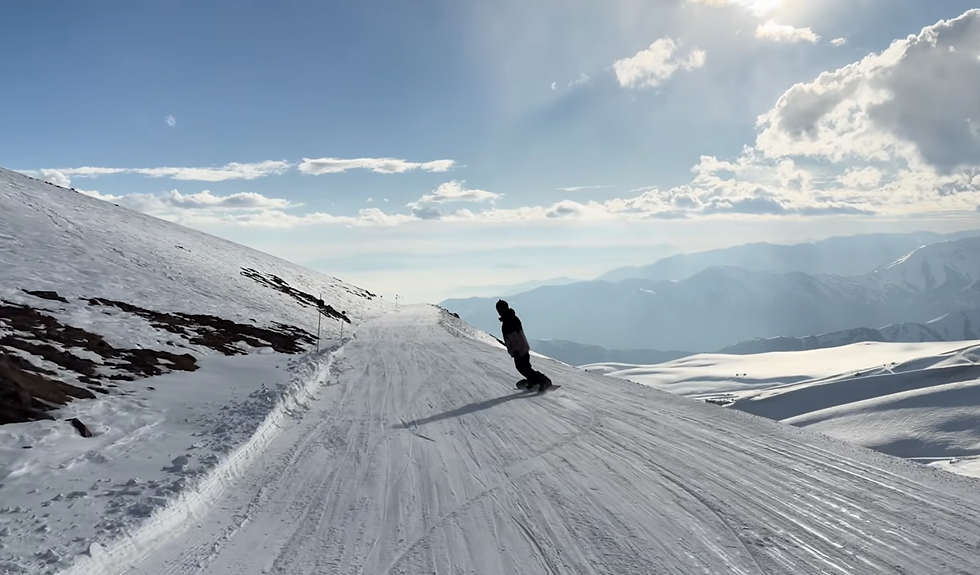
The resorts above Santiago sit high — Valle Nevado's base is around 3,000m and it tops out near 3,670m. That's above the treeline, and it stays above the treeline. You're riding on huge open faces with no trees, no fences, and nothing to give you scale except other people and the ridgelines.
If you've spent your riding life in Whistler or the Rockies or New England, this is genuinely disorienting for a day. Distances lie to you. A face that looks like a two-minute run takes twenty. Then you adjust, and it becomes the best thing about the place: you can look at a whole mountain and pick a line anywhere on it.
2. The altitude is real
Valle Nevado's top lift sits near 3,670m. Portillo tops out around 3,310m. For most riders coming from North America or Europe, that's higher than anything you ride at home, and the first day will tell you about it.
You'll be more out of breath than you expect on a bootpack. You'll get tired earlier. The sun at that altitude is aggressive in a way that catches people out — I've seen more sunburn on Andes trips than anywhere else.
Take the first day easy, drink far more water than feels necessary, and use proper sunscreen. Do those three things and by day two you're fine.
3. You're ninety minutes from an international capital
This is the practical advantage that sells the trip.
Santiago is a major city with a proper international airport, and the Tres Valles resorts are roughly 60km away — about an hour and a half up the road, traffic permitting. You can land in the morning and be riding in the afternoon, or ride all day and be eating extremely good food in the city that night.
Compare that to most world-class terrain, which requires a flight, a transfer, and a second transfer. Here, the mountain is the day trip.
Note the road, though. Route G-21 up to Farellones is a long series of tight switchbacks with a serious elevation gain, chains are mandatory, and on weekends there are enforced uphill and downhill time windows. Don't plan on driving down at whatever time suits you. Check the schedule.
4. The interconnect makes it huge
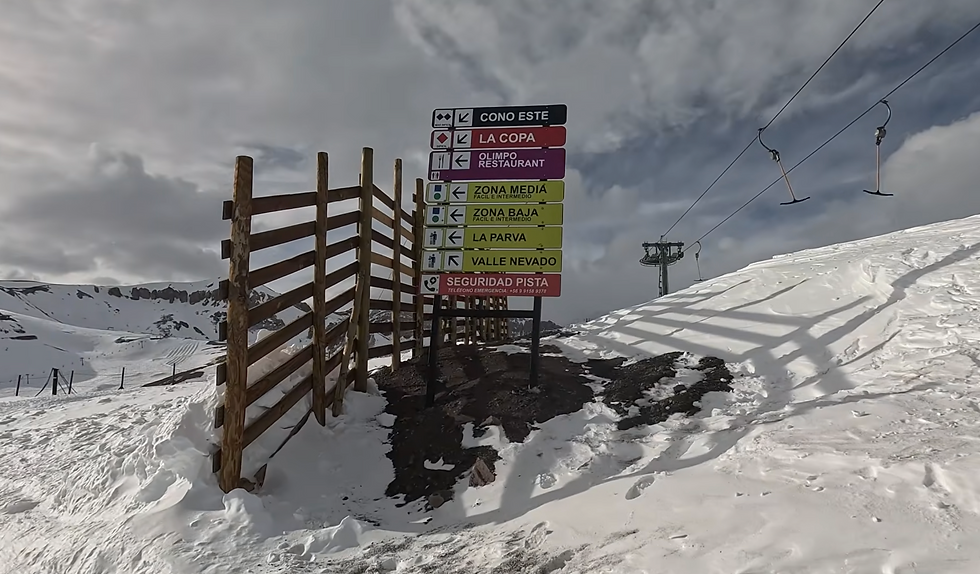
Valle Nevado, La Parva and El Colorado sit next to each other and together form Tres Valles — the largest skiable domain in South America, and as of recent seasons the connection between them has been properly consolidated.
That means you can ride three mountains in a trip without changing where you sleep. El Colorado in particular is the one people overlook, because international visitors default to Valle Nevado or Portillo. It's the closest to Santiago, it's the biggest in terms of raw runs, and it has some genuinely serious terrain if you know where to look — or if you take a guide, which for a first trip here I'd recommend.
5. It's empty
Midweek, outside of the Chilean school holidays, these mountains are quiet in a way that peak-season North America and Europe simply aren't anymore.
You'll share the hill with hotel guests, some locals, and — this is a fun detail — national ski teams training in their off-season. There's something clarifying about riding a lift with a World Cup team while the run below you is completely untracked.
The exception: the last two weeks of July are Chilean student holidays. Everything is busier and everything is more expensive. Plan around it.
6. Chile is skinny, and that means two completely different trips
This is the part most people don't do, and it's the reason to stay longer than a week.
The central Andes above Santiago are high, dry and treeless. Head south — Nevados de Chillán, Corralco — and you're riding volcanoes. Lower elevation, wetter and heavier snow, actual trees including araucaria forests that look like nothing else on earth, and natural hot springs at the base of the mountain.
Two ends of the same country, two entirely different riding experiences, and the southern resorts get some of the biggest snowfall totals in the Southern Hemisphere.
7. The season lines up with the gap in your life
Chilean resorts generally open mid-to-late June and run into September or early October, depending on the year. August is typically when the base is deepest.
Which means: instead of spending five months off snow, losing your legs and forgetting what your board feels like, you get a full reset in the middle of your summer. You come home sharp. You start your home season in December already riding well instead of spending four days getting back to where you were in April.
Honestly, that alone is worth it.
What I'd tell you before you book
It's not Japan. Don't come here expecting bottomless powder every day. The central Andes get storms and they can be excellent, but wind is a real factor at that altitude and it can affect the snow and close lifts. Come for the terrain, the altitude and the emptiness. If you get a storm, that's a bonus.
Flat light is hard here. No trees means nowhere to hide when the cloud comes in. A good contrast lens matters more in Chile than almost anywhere.
It's not a budget trip. Realistically a week runs somewhere in the region of $2,800–3,800 per person from North America including flights, and Portillo's all-inclusive weeks start higher. It's cheaper than a comparable week in Europe once you factor everything, but it's not cheap.
Take a guide for at least a day. The good terrain here is not obvious from the trail map, and the boundaries and rules work differently than what you're used to. One day with someone local will change the other five.
The bit that stays with you
What I remember most isn't a specific run. It's standing at the top of something enormous with the Andes stretching out behind it, knowing that back home it's the middle of summer and everybody I know is at the beach.
Snowboarding is supposed to be seasonal. Chile is the place that reminds you it doesn't have to be.
If you've been thinking about a southern hemisphere trip, this is the one I'd do first.


Comments